
If you’re thinking about running YouTube Ads, one of the first questions you may have is how much you actually need to spend.
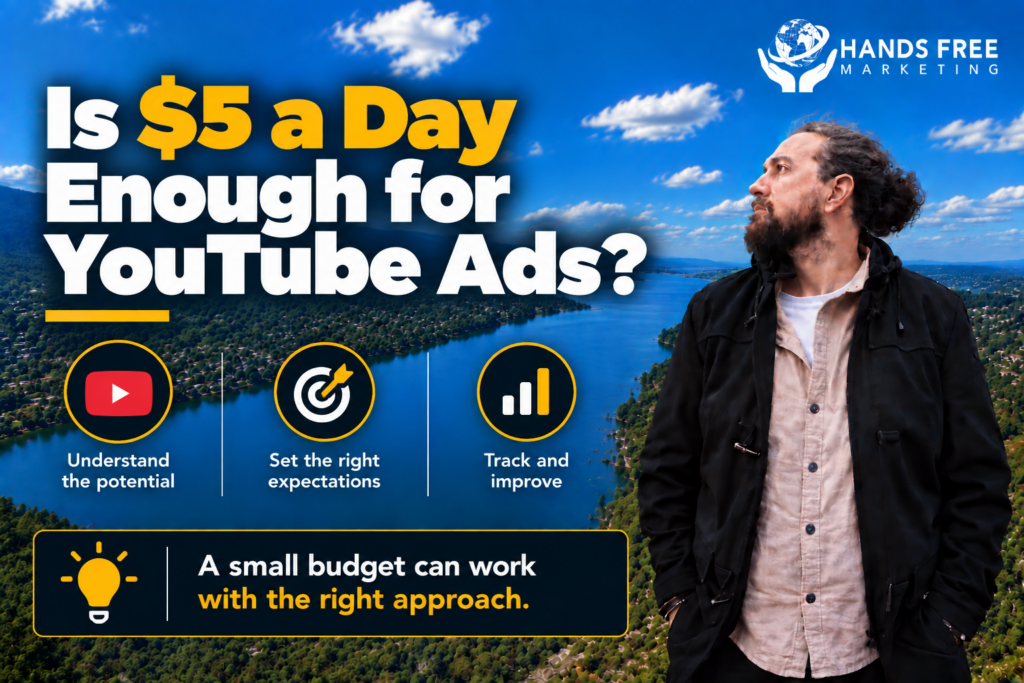
A $5-a-day budget sounds affordable. But is it enough to get meaningful results?
The short answer is: it depends on what you’re trying to achieve.
A small budget can be useful for testing your audience, creative, and campaign setup. However, $5 a day may not provide enough data or reach if your main goal is generating consistent leads or sales.
Here’s what you should consider before starting.
What Does $5 a Day Actually Give You?
A $5 daily budget works out to roughly $152 over an average 30.4-day month.
Google Ads uses an average daily budget, meaning your spending can vary from day to day. For most campaigns, Google can spend up to twice the average daily budget on a particular day, while the monthly spending limit is generally based on 30.4 times the average daily budget.
Therefore, $5 a day shouldn’t necessarily be viewed as a strict $5 spending limit every single day.
Instead, think of it as an average amount you’re comfortable spending over the month.
Can YouTube Ads Work With $5 a Day?
Yes, but expectations need to be realistic.
A small budget can be useful when you’re trying to learn what works. For example, you could use it to test different videos, audiences, or messages before committing more money.
YouTube Ads can be used for different goals, including building awareness, driving website traffic, and generating conversions. Google also provides targeting and measurement options to help advertisers understand how their campaigns are performing.
However, your budget affects how frequently your ads can appear and how much data your campaign can collect.
With only $5 per day, you may need more time before you have enough information to make confident decisions.
$5 a Day Is Better for Testing
If you’re a small business that has never used YouTube Ads before, starting small can make sense.
Rather than immediately spending hundreds or thousands of dollars, you could use a smaller budget to test:
- Different video ads
- Audience targeting
- Locations
- Headlines and messaging
- Calls to action
- Landing pages
This gives you an opportunity to see how people respond before increasing your investment.
Google itself recommends starting small and checking campaign performance after applying a new budget.
The important thing is to treat the initial campaign as a learning period rather than expecting immediate results.
When $5 a Day May Not Be Enough
A $5 daily budget becomes more limiting when you’re trying to generate conversions.
For example, imagine you’re a service business that wants people to submit quote requests through your website.
If your campaign only receives a small amount of traffic, it could take a long time to generate enough conversions for you to properly evaluate performance.
Google notes that budget affects how quickly video campaigns can optimise. For conversion-focused video campaigns, Google recommends budgets based on the expected cost per conversion rather than simply choosing an arbitrary small amount.
Therefore, the right budget should be connected to your actual business goal.
Your Goal Matters More Than the $5
Before deciding on a budget, ask yourself what you want your YouTube Ads to accomplish.
Brand Awareness
If your goal is simply to get your business in front of more people, a smaller budget may still be useful.
You may be able to reach a targeted audience and build awareness over time.
Website Traffic
If you want people to visit your website, $5 per day can provide some traffic. However, the amount of traffic you receive will depend on factors such as your targeting, bidding, competition, and creative.
Leads
Generating leads usually requires more careful tracking and enough budget to collect meaningful conversion data.
A very small budget may limit how quickly you can determine whether your campaign is generating qualified enquiries.
Sales
For an e-commerce business, the budget needs to make sense in relation to your average order value, conversion rate, and target return.
If one sale is worth $100 to your business, spending $5 per day might be a reasonable starting point for testing. However, you’ll eventually need enough data and budget to determine whether the campaign can generate profitable sales consistently.
Don’t Forget About the Video
Your budget isn’t the only factor that determines whether YouTube Ads work.
The quality and relevance of your video also matter.
A great campaign can struggle if the video doesn’t capture attention or clearly communicate the offer.
Your video should quickly explain:
- What your business offers
- Who the product or service is for
- Why someone should care
- What they should do next
You don’t necessarily need an expensive production.
A simple, clear video that speaks directly to your target customer can be more useful than an expensive video that doesn’t communicate the offer effectively.
Targeting Matters Too
Even with a good video, you don’t want to show your ads to everyone.
YouTube campaigns can use different targeting options to reach relevant audiences, including demographics, topics, keywords, and other audience signals.
For a local New Zealand business, for example, you may want to focus your advertising on specific locations rather than targeting the entire country.
However, extremely narrow targeting can also limit your reach.
The goal is to find a balance between reaching the right people and giving the campaign enough room to perform.
When Should You Increase the Budget?
Don’t increase your budget simply because you aren’t getting results.
First, look at what the campaign is actually telling you.
Are people watching the videos?
Are they clicking?
Are they visiting your website?
Are they completing the action you want?
If the campaign is producing good results but is limited by budget, increasing the budget may help you capture more opportunities. Google provides budget tools and recommendations to help advertisers understand the potential impact of budget changes.
On the other hand, if the campaign isn’t producing useful results, increasing the budget may simply increase your costs.
Fix the campaign first, then consider scaling it.
So, Is $5 a Day Enough?
It can be enough to start testing YouTube Ads, but it may not be enough for every goal.
For a small business with a limited budget, $5 per day can provide a low-risk way to start learning about YouTube advertising.
However, if your goal is consistent leads, sales, or conversions, you’ll need to consider your expected cost per result and whether $5 per day gives the campaign enough room to gather useful data.
Ultimately, the right budget isn’t determined by a single number.
It’s determined by your goals, audience, competition, expected conversion cost, and how much you’re willing to invest to acquire a customer.
Need Help With YouTube Ads in New Zealand?
Starting YouTube Ads with a small budget can make sense, but it’s important to know what you’re trying to achieve before spending your money.
Hands Free Marketing helps businesses across New Zealand with YouTube Ads strategy, campaign setup, audience targeting, creative testing, and ongoing optimisation.
If you want clarity instead of guesswork, get in touch.
👉 Book your free 15-minute consult
📞 027 590 9421
📧 jevon@handsfreemarketing.com
🌐 Web Design Hawke’s Bay